
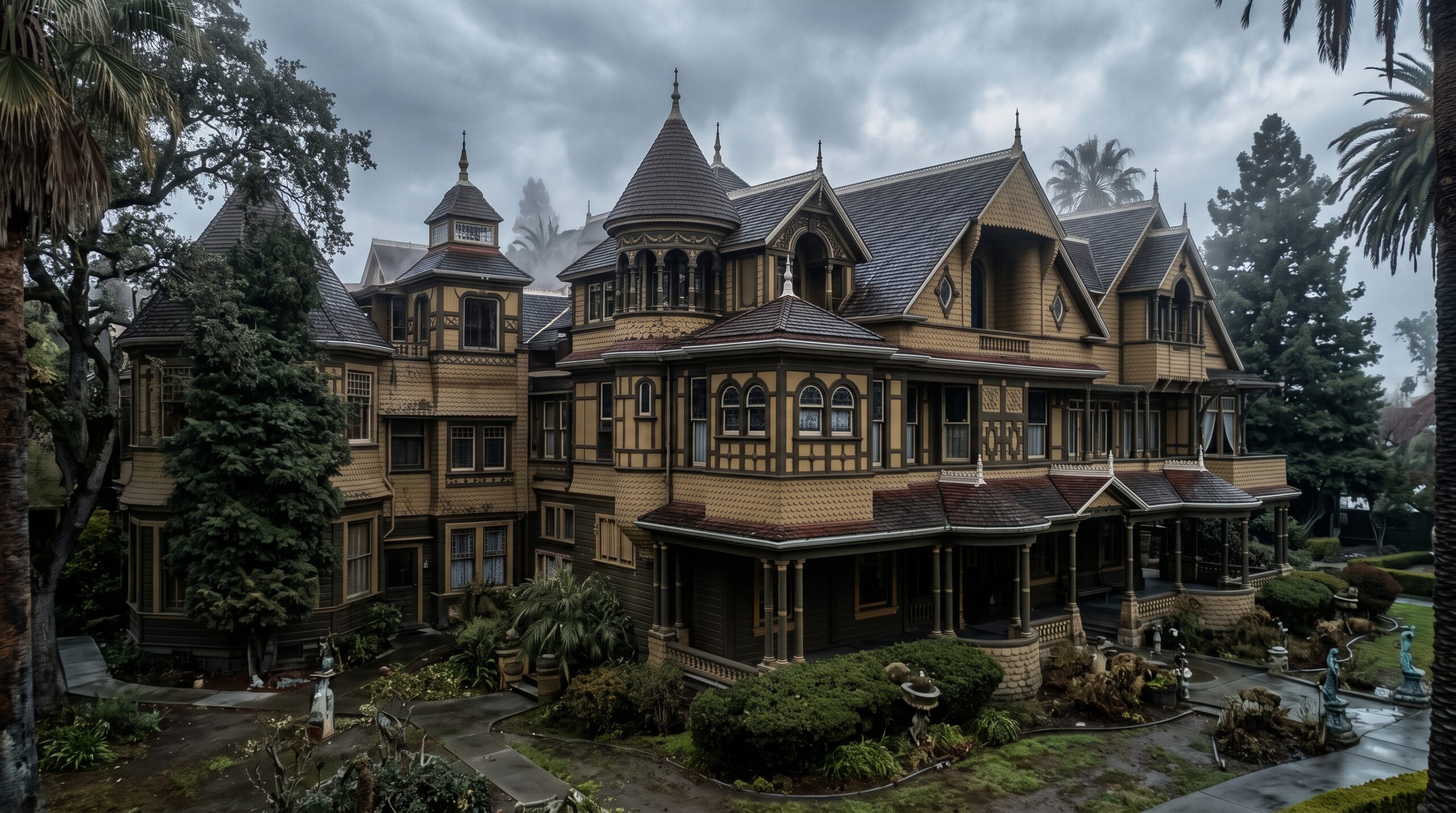
Winchester Mystery House: The Strange Design of a Victorian Mansion
Introduction: A Mansion Unlike Any Other
In San Jose, California, stands a mansion unlike almost any other in America. Known as the Winchester Mystery House, this sprawling Victorian-era residence is famous for its unusual architecture, confusing hallways, staircases that lead nowhere, and doors that open onto unexpected spaces.
For decades, stories about the mansion have fascinated visitors, historians, and paranormal enthusiasts. Some believe its strange design was connected to the personal fears of its owner, Sarah Winchester. Others argue that the mansion’s unusual features are the result of years of continuous construction and changing architectural plans.
But how much of the Winchester Mystery House mystery is based on documented history, and how much comes from popular legend?
1. Who Was Sarah Winchester?
Sarah Winchester was the widow of William Wirt Winchester, whose family became wealthy through the Winchester Repeating Arms Company. After her husband died in 1881, Sarah inherited a substantial fortune.
In 1884, she purchased a farmhouse in San Jose, California, and began expanding it into the enormous residence that would eventually become famous as the Winchester Mystery House.
Construction continued for decades, with rooms, corridors, and architectural features added and modified over time. The result was a sprawling mansion that reflected an unusual and constantly changing building process.
Sarah Winchester’s private life has inspired countless stories, but separating historical facts from later speculation remains essential to understanding her legacy.
2. The Legend of the Spirits
One of the most popular stories surrounding the Winchester Mystery House suggests that Sarah Winchester feared being haunted by the spirits of people killed by Winchester rifles.
According to the legend, a spiritual adviser told her that she needed to keep building her house to protect herself from these spirits. Some versions claim that construction had to continue constantly to keep supernatural forces away.
However, there is no conclusive historical evidence proving that Sarah Winchester built the mansion for this reason. The story became a major part of the house’s reputation, helping transform an unusual private residence into one of America’s best-known haunted-house legends.
The distinction between documented history and folklore is one of the most intriguing aspects of the Winchester Mystery House mystery.
3. Staircases That Lead Nowhere
Perhaps the mansion’s most recognizable features are its unusual staircases.
Some staircases rise only a short distance before ending at a ceiling. Others appear to lead toward unexpected walls or connect spaces in confusing ways. These architectural oddities have helped create the impression that the mansion was designed according to a secret plan.
In reality, the house underwent repeated alterations over many years. Changes to the building’s layout, combined with its extensive additions, help explain why some of its features seem so impractical.
Even so, walking through these spaces can feel like entering a maze in which the normal rules of residential architecture no longer apply.
4. Doors That Open Into Walls
Imagine opening a door and discovering that there is no room beyond it—only a wall or an unexpected drop.
The Winchester Mystery House contains unusual doors and architectural transitions that have become central to its reputation. Some are associated with the house’s confusing layout, while others have been exaggerated in popular retellings.
These features encourage visitors to question how the mansion was planned and why its design became so unconventional.
Although the unusual doors are real architectural curiosities, claims that they were deliberately created to confuse spirits belong to the realm of legend rather than established fact.
5. A Maze of Rooms and Corridors
The mansion is famous for its extensive interior, featuring numerous rooms, narrow passageways, unexpected turns, and unconventional connections between spaces.
Instead of following the straightforward layout found in many homes, the building developed through successive periods of construction and renovation. This long process contributed to its unusual appearance.
The mansion’s complexity has inspired theories about hidden meanings and supernatural intentions. Yet a more grounded explanation is that years of additions and modifications created an architectural puzzle that was never intended to function like an ordinary modern house.
For visitors, exploring its corridors remains one of the most memorable parts of the experience.
6. The Mystery of the Number Thirteen
Another popular detail associated with the Winchester Mystery House is the number thirteen.
Stories about the mansion describe architectural features arranged in groups of thirteen, including windows, steps, or other design elements. These details have become part of the property’s mysterious reputation.
However, individual claims about the number thirteen should be checked against reliable historical or architectural documentation rather than accepted simply because they appear in paranormal accounts.
Whether viewed as a deliberate symbol or an intriguing coincidence, the number thirteen adds another layer to the stories surrounding Sarah Winchester’s extraordinary home.
7. What Happened After Sarah Winchester Died?
Sarah Winchester died in September 1922. After her death, the mansion’s contents were sold, and the property eventually became a public attraction.
Over the years, it developed into a major destination for people interested in unusual architecture, California history, and haunted-house folklore.
Today, the Winchester Mystery House is known both for its elaborate Victorian design and for the legends that surround its former owner. Guided tours allow visitors to explore portions of the property and learn about its construction, architectural features, and history.
The mansion’s continued popularity demonstrates how a real historical place can become intertwined with stories that evolve across generations.
Is the Winchester Mystery House Really Haunted?
There is no conclusive scientific evidence establishing that the Winchester Mystery House is haunted. Reports of strange experiences and supernatural encounters are part of its popular reputation, but they do not prove the existence of ghosts.
The mansion’s unusual design has a historical context: it was expanded and modified over many years, producing architectural features that can seem confusing or inexplicable at first glance.
For paranormal enthusiasts, however, the legends remain an important part of the experience. The combination of an extraordinary building, a wealthy and private owner, and decades of storytelling makes the house a compelling subject for mystery lovers.
Perhaps its greatest mystery is not whether spirits inhabit its rooms, but how the story of Sarah Winchester became so closely connected with the mansion itself.
Conclusion: A Victorian Mansion Full of Questions
The Winchester Mystery House remains one of America’s most fascinating architectural landmarks. Its unusual staircases, unexpected doors, winding corridors, and complicated history have helped create an enduring atmosphere of mystery.
Although popular legends claim that Sarah Winchester built the mansion to escape restless spirits, the evidence does not establish that explanation as historical fact. What is certain is that her residence became an extraordinary example of unconventional Victorian-era architecture.
For anyone interested in American mysteries, the mansion offers a fascinating opportunity to explore the boundary between history, architecture, and folklore.
Would you explore the Winchester Mystery House after dark, or would its strange corridors be enough to make you turn back? Share your thoughts in the comments.
Editorial note: Supernatural stories in this article are presented as legends, not verified facts.
One Comment